
Sources for Farmington Previous Residents
A house history needs both an ownership layer and a household layer. The Davis County Recorder can show transfers, mortgages, liens, plats, and legal descriptions. A city directory or reverse directory may show an occupant. The Clipper can date a move, marriage, death, or community event. Census schedules add household members at released intervals. Permits and code records may identify an applicant if a targeted request produces a releasable file.
| Source | Years It Covers | Where Held | What It Shows |
|---|---|---|---|
| Davis Recorder land records | Office says since 1850; 1870 collection milestone | Recorder, Property Search, terminals, REDI-Web | Deeds, owners, legal descriptions, liens |
| Recorder modernization | 1981 milestone | Davis County Recorder | Computerization and microfilm transition |
| Farmington directory | 1922-23 verified | Local and Utah historical collections | Population, businesses, names and address clues |
| Davis County Clipper | 1892-1992 digital; most through 2020 | Library and museum | Moves, obituaries, notices, businesses |
| Federal census | 1850 onward as releases permit | NARA, FamilySearch, libraries | Household, age, relationship, residence |
| Historic Building Records | 118 Farmington entries inspected | Marriott Digital Library | Named houses, addresses, building dates |
| Permits and code | Exact public years not located | Farmington Community Development/GRAMA | Applications and notices if releasable |
Start with the Recorder for a present parcel, with a directory or Clipper for a known historical year, and with the Archives for older vital records. The online cutoff for every Davis land record type is not stated, so an older result may require a terminal, microfilm, or deed book.
Farmington Previous Residents Start at Parcels
Enter the current situs address into Davis County Property Search 2.0. Zoom the basemap, click the parcel, and copy the current owner, parcel or serial number, legal description, acreage, mailing address, ownership history, and map location. The mailing address may differ from the Farmington situs. That difference can indicate an out-of-town owner, estate, trust, or manager, but it does not identify the people living at the house.
The county calls the application informational and says its data may be 24 hours old or older. Use the parcel card to find a Recorder document entry, then verify the title trail with the Recorder. The Davis County Property Search and public map give the discovery path. A certified copy or legal title answer belongs to the Recorder.
Farmington Previous Residents in Deeds
The deed chain is a sequence, not a single search. Begin with the current owner's purchase deed. Note the grantor, grantee, recording date, document entry number, parcel ID, and legal description. Search the grantor as a grantee in an earlier transfer. Repeat until the address reaches an older book or the legal description changes through a subdivision. Exclude mortgages, releases, and liens when looking for title transfers.
- Pull the current owner and legal description from Davis Property Search.
- Find the transfer that placed that owner on title in the Recorder index.
- Search the seller as grantee and compare the same legal description.
- Track trusts, estates, executors, spouses, and spelling variants as separate names.
- Ask the Recorder about terminals, microfilm, deed books, or certified copies when the web trail ends.
- Grantor
- The party transferring an interest in recorded land.
- Grantee
- The party receiving the recorded interest.
- Chain of title
- The linked sequence of transfers for one parcel.
- Legal description
- The formal land description that may remain stable when a street number changes.
Davis County states that land records have been safeguarded since 1850. Its history panel marks 1870 as a historical collection milestone and 1981 as modernization and microfilming. These are milestones, not a confirmed online cutoff.
Property Watch and Farmington Previous Residents
Davis County Property Watch is a free opt-in alert service for recorded deed and mortgage categories. Registration asks for an owner, email, and a parcel number in the XX-XXX-XXXX format. The county says an email alert can arrive within 30 days. It is a forward-looking fraud-awareness tool, not a historic list of previous residents, but it can help a present owner notice a new recorded instrument.
The Davis County Property Watch page explains the current deed and mortgage alert.
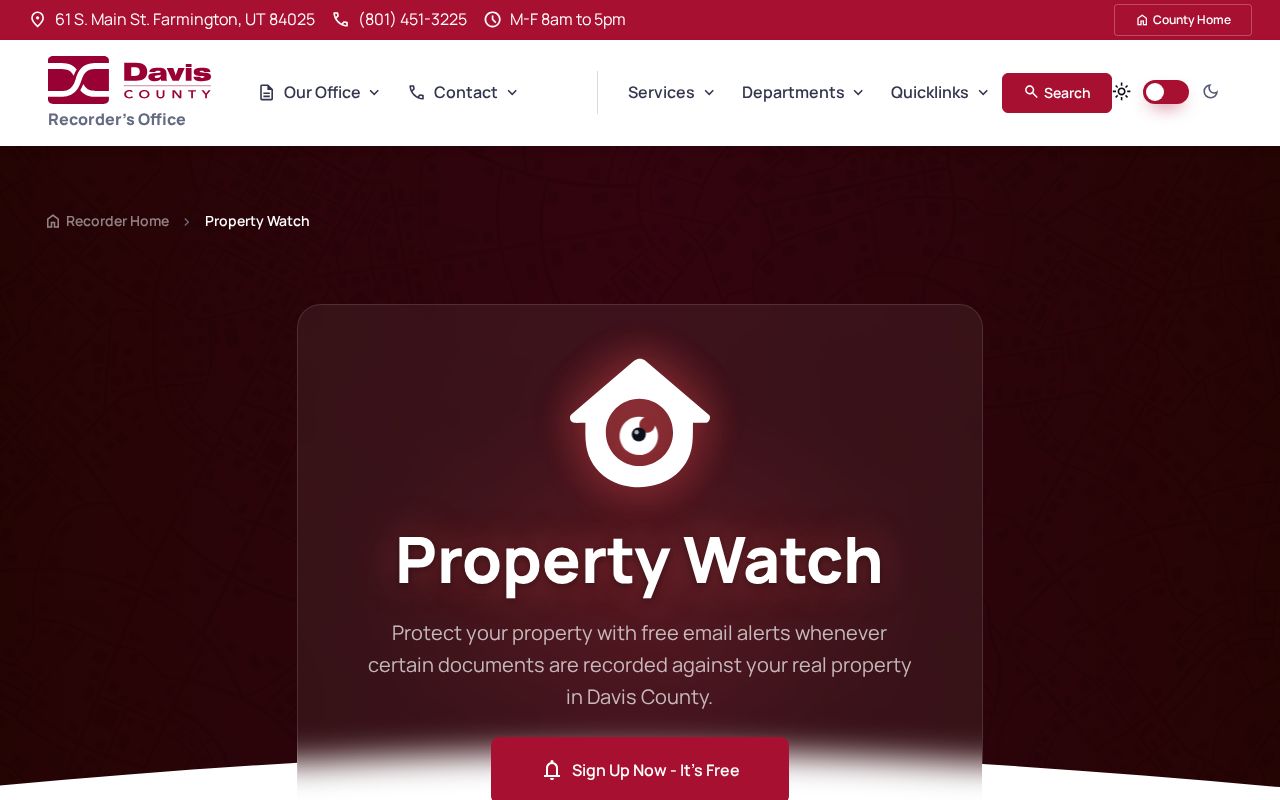
The Property Watch capture shows the parcel and owner fields used for a current alert. For past residents, return to the Recorder index and work backward from the document chain.
Access comparison. The public Recorder search and terminals are free. REDI-Web is listed at $25 per month, with $1 digital copies, while counter and mail copies have separate fees.
Farmington Past Residents and Census Years
Past residents may appear in a directory without owning the land. The verified Farmington directory reference is 1922-23. Pair it with the 1920 and 1930 census, then use a Clipper notice or deed to explain an address change. The 1892-1992 digital Clipper run and the museum's later bound issues help fill gaps between federal census years.
- Copy the exact name, address, occupation, and household marks from the directory.
- Check the reverse address pages for nearby occupants and the same street.
- Compare the closest released census for household members, ages, and relationships.
- Search Clipper issues for a move, marriage, death, business, or address notice.
- Use a deed, obituary, cemetery clue, or probate record to close the period.
A disappearance from a directory does not prove that a family moved. It can mean a skipped issue, a spelling difference, an unlisted household, or a gap in the local run. The Farmington city directory collections page treats the shelves and entry-reading method separately.
Farmington Previous Residents in 1922-23
The 1922-23 local directory is useful because it records a population of 1,450 alongside businesses, civic offices, school information, and agricultural occupations. It captures a Farmington shaped by orchards, livestock, fruit growing, and the Utah Central Railroad connection. A name in that volume can be tested against the Main Street and Clark Lane historic districts, the Clipper, census, and the Recorder.
The publisher, full year run, and exact shelf were not identified in the official public summary. Do not fill that gap with a guessed Polk sequence. Ask Davis County Library, the Farmington Historical Museum, or the Utah Historical Society for the physical or digitized volume and its abbreviation key.
Farmington House History and Previous Residents
Utah Historic Building Records returned 118 Farmington address-based entries. The collection joins a building name, street number, city, county filter, and PDF. The Hector C. Haight House or Union Hotel at 208 North Main, the Steed, Thomas and Laura House at 226 South 200 East, and the Knowlton, George Quincy House at 93 East 400 North are examples of named properties that can help identify a house when a surname or street search fails.
Farmington's Main Street district covers about 1853-1961. Clark Lane reflects a family settlement pattern from 1856-1970, including later subdivision of large family lots. The city landmark register uses current owner and address information from Davis County Recorder records, creating a useful official bridge from historical house research to a present parcel. A named building still does not prove that a person lived there in every year.
Farmington Previous Residents and Old Addresses
Farmington's 1853 grid, directional street names, Main Street landmarks, family compounds, and later subdivisions can make an old address hard to match. The research did not verify a Farmington-wide street-renumbering year. Keep the original North or West wording, search the house name and nearby landmark, and compare the legal description when the Recorder record appears.
Sanborn map coverage for Farmington was not confirmed. The Library of Congress guide can explain a search method, but it is not proof that a Farmington map exists for every year. Use city GIS, Historic Building Records, the Clipper, and the Recorder rather than assuming a missing map or directory year.
Farmington Previous Residents at Trail Endpoints
When a former resident dies, the Clipper, museum archive, cemetery clue, death register, obituary, and probate docket may identify relatives or an estate. The Davis County digital vital collection includes 1898-1905 death registers with last residence, birthplace, occupation, marital status, cause and reporter fields. Current death certificates are restricted under Utah Code section 26B-8-125, while public opening occurs after 50 years.
A public probate case can point to a personal representative or estate transfer. Then check the Recorder for an executor, trustee, or heir deed. Court privacy rules still apply, and a public obituary does not grant permission to contact living relatives repeatedly. It is a historical endpoint, not a current whereabouts source.
Lawful house history. Previous-resident research in Farmington is for family history, documented property history, and personal curiosity. Do not use an old address to track, harass, threaten, or surveil a living person. Utah section 76-5-106.5 addresses repeated directed conduct such as monitoring, following, and unwanted contact.
Document a Farmington Previous Residents Match
Keep a short evidence log for every historical household clue. Record the publication or office, exact title, date, page or document number, street wording, person name, and the detail that connects the result to the parcel. A directory occupation or newspaper notice can distinguish two people with the same name. A deed legal description can confirm that an old address is the same tract after a street label changed.
Separate three conclusions: the person appeared at an address, the person held an ownership interest, and the person was related to another household. Each requires different evidence. Use the Clipper, museum, census, death registers, court docket, and Recorder in combination, while marking an inference as an inference. If the trail ends at a living person, do not turn a historical source into a present-day contact list.