
Farmington City Directory Collections
The best verified Farmington city directory reference comes from the Main Street Historic District page. It identifies a 1922-23 directory with a population of 1,450 and a rich local snapshot: stores, dentists, a floral company, a drug store, a pool hall, a barber, a blacksmith, an auto garage, grocers, a physician, a shoemaker, a contractor, banks, hotels, county offices, the school district, apiarists, dairy farmers, livestock, and fruit growers. It is a date-specific source, not evidence of a continuous run.
| Collection | Years | Where Held | Access |
|---|---|---|---|
| Farmington city directory | 1922-23 verified | Local and Utah historical collections | Ask library, museum, or Historical Society |
| Utah City Directories Collection | Run-specific | Utah Historical Society | Online catalog or research center |
| Davis County Clipper | 1892-1992 digital; most through 2020 in museum | Library digital library and museum | Online or appointment |
| Historic Building Records | 118 Farmington results inspected | Marriott Digital Library | Searchable PDFs |
| Davis births and deaths | 1898-1905 | Utah State Archives | Free index and linked images |
| FamilySearch Davis catalog | Catalog labeled 1869-1953 | FamilySearch | Series-specific images and microfilm |
No official catalog established the exact Farmington publisher or a full year-by-year run beyond 1922-23. Treat that gap as a research result. Ask for scattered local issues, county gazetteers, neighboring-city editions, old phone books, and reverse pages rather than describing an unverified continuous Polk series.
Farmington City Directory Shelf
Davis County Library headquarters is at 133 South Main in Farmington. The branch offers a microfilm reader, catalog, scanning, public internet, and digital research access. Its digital library links searchable Davis County Clipper issues from 1892 through 1992. This makes the library the first call for a missing directory year, a newspaper notice, or an old address that does not appear in a modern search.
The Davis County Library digital library is especially useful for issue-level searches. The Farmington Historical Museum is the next shelf. It holds family histories, letters, diaries, maps, school records, photographs, newspapers, and most of the Clipper after the digital run, through 2020. Research is by appointment, and the museum is open Wednesday from 1 to 4 or by appointment.

The digital-library screenshot shows the online half of Farmington's city directory and newspaper trail. The museum image below shows why later bound issues require a separate request.
The Farmington Historical Museum archive page documents the later bound volumes and appointment access.
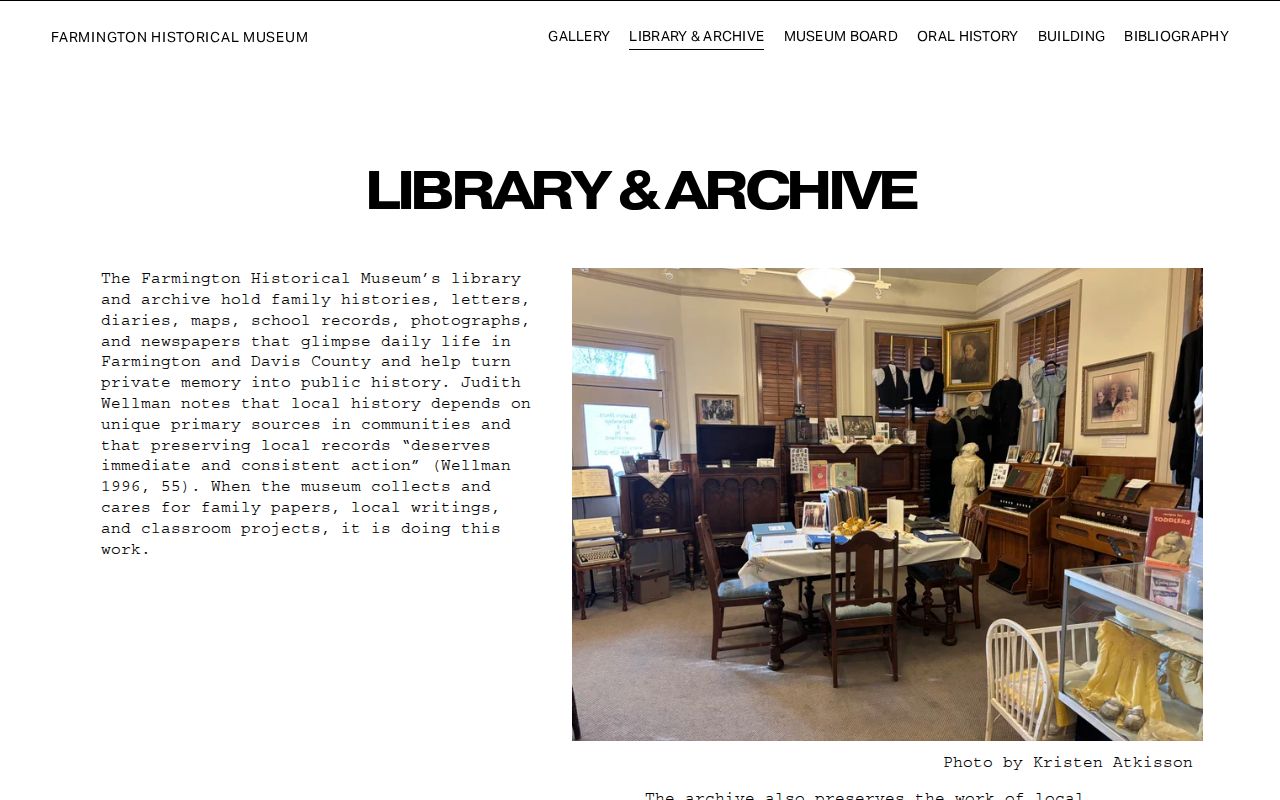
Use the Farmington Historical Museum archive for local papers and family material that a typed directory cannot supply.
Read a Farmington City Directory Entry
A city directory is a compact record of a time and place. A name entry may pair a person with an occupation, spouse or household mark, and street address. An address section reverses the work: begin with the road and number, then read the occupant names. The actual 1922-23 printed entry image was not exposed in the inspected source, so the volume itself should be checked before assigning symbols or abbreviations.
| Publication and year | Farmington city directory, 1922-23. |
|---|---|
| Population | The historic district summary records 1,450 people. |
| Local context | Businesses, county offices, school district, professions, and agricultural occupations. |
| Name and address | Verify spelling, directions, street wording, and household marks in the volume. |
| Publisher and key | Not located in the official public summary; inspect the physical or digitized run. |
- Criss-cross directory
- An address-ordered section that lets a reader start with a street.
- Householder index
- A name or household entry used to locate a person in the volume.
- Abbreviation key
- The volume's explanation of short forms and symbols. Photograph or note it first.
- Pink pages
- The address section in Polk-style directories, according to Utah Historical Society guidance.
Farmington City Directory Reverse Pages
The reverse portion of a city directory is often more useful than the alphabetical name section when the address is known. Find the street, check the number and direction, and note every listed occupant or business. Then return to the name section for occupation and other marks. Search North and West directions exactly as printed. The historic Farmington grid and later road labels can make a current street string a poor substitute for the old wording.
Farmington-specific continuous directory years are not verified. A directory question may therefore move from a physical volume to the Clipper, a census schedule, a deed, or a Historic Building Record. Keep the citation, page, original address, and any nearby landmark. Those small details make it possible to connect a historical directory clue with a modern parcel without pretending the sources say the same thing.
Farmington City Directory and Clipper
The Davis County Clipper began in 1892 and ended in 2020. Library digitization covers searchable issues from 1892-1992, while the museum holds most later bound issues. A notice may place a person at a street, announce a move, record a marriage, report a death, name a business, or mention a school and community event. Newspapers can establish a date when a directory year is missing, but OCR errors and married names require variant searches.
Search a surname with an address, date, spouse, house name, or event. If the digital scan misses a word, ask the library about microfilm and the museum about the bound issue. The museum's family histories, letters, diaries, photographs, school records, and local historians can add context. These collections support family history and reconnection; they are not a current household roster.
Farmington City Directory Historic Buildings
The Utah Historic Building Records collection returned 118 Farmington entries in the inspected results. Rows combine a building or property name, street address, city, county filter, and a PDF record. Examples include the Taylor, John, Janet and May Rich House at 49 East 500 North; the Haight, Hector C. House or Union Hotel at 208 North Main; the Steed, Thomas and Laura House at 226 South 200 East; the Stayner, Steed House or Farmington Hotel at 79 South 100 East; and the Knowlton, George Quincy House at 93 East 400 North.
These records are not resident lists. They are a bridge between a named house, an old address, and a person or family linked to its history. Compare a building record with a Recorder parcel, a directory page, a Clipper notice, or a census household. The city's landmark register can also crosswalk a listed resource to the current owner name and address shown by Davis County Recorder records.
Farmington City Directories with Census
A city directory is a point in time. Census schedules add household composition, age, relationship, occupation, and residence, but federal release rules and place names matter. For a 1922-23 directory, compare the 1920 and 1930 census. Search Farmington precinct, township, Davis County, and nearby place names because the historical geography may not match today's city line.
- Find the person in the known directory year and copy the exact name and address.
- Search the reverse pages for the same street and nearby entries.
- Check the closest released census for household members, ages, relationships, and occupation.
- Use a Clipper notice, deed, or historic building record to resolve a move or name change.
- Close the trail with an obituary, cemetery clue, or public vital index, respecting access rules.
Disappearing from one city directory does not prove a move or death. It can mean a skipped issue, a different spelling, an unlisted person, or a change in publication. Record gaps are signals to switch sources.
Farmington City Directory Vital Registers
Utah State Archives holds Davis County birth and death registers from 1898-1905, with linked images and fields that modern directory pages do not show. Birth entries can include date and place, sex, race or color, parents, residence, informant, and an assigned number. Death entries can include age, residence term, birthplace, marital status, occupation, last residence, cause and date of death, and reporter.
Current certificates are handled by Davis County Health or other custodians under Utah Code section 26B-8-125. Public opening rules are 100 years for births, 50 for deaths, and 75 for marriage and divorce records. A historical register can be free to inspect while a current certified copy requires eligible relationship, identification, and a fee. Do not treat an archival name as proof of a current address.
Trace Families in Farmington City Directories
Start with the name index for the known Farmington city directory year. Copy every detail, including a middle initial, spouse mark, occupation, and street direction. Turn to the address section, then search the next available issue by both surname and address. Add the 1920 or 1930 census, Clipper notices, a deed, and a cemetery or obituary source. A former resident's story becomes stronger when two records agree on a date and place.
FamilySearch's Davis County catalog is labeled 1869-1953 and includes series for births, deaths, mining, courts, and other county material. Catalog fields include place, keywords, titles, authors, subjects, surnames, call number, film or image group, and availability. An online catalog entry does not promise that every image is open without a login or local center. For current identity, use the official custodian and the separate Farmington resident lookup process.
Historical reading rule. A Farmington city directory entry usually identifies an occupant, subscriber, or business connection. The Davis County Recorder is the authority for title and recorded ownership.